More countries are using Cat DDOs: Here are three things to know
What do we know about the instrument that accounts for half of all pre-arranged financing globally?

It has been a year since Hurricane Beryl swept past the main islands of St. Vincent and the Grenadines as a Category 4 storm. Most of the population escaped the worst of it—but Union Island, at the southern tip of the archipelago, suffered catastrophic damage. Just months later, in April 2025, the government secured its second Catastrophe Deferred Drawdown Option (Cat DDO) from the World Bank. In exchange, it committed to a set of reforms aimed at strengthening disaster preparedness, including the adoption of a national disaster management policy.
Hurricane Beryl offered a stark reminder: Caribbean economies remain dangerously exposed to climate shocks. In such contexts, access to pre-arranged finance can be a question of survival.
As the World Bank prepares for its 21st replenishment of the International Development Association (IDA) — the branch of the Bank that provides concessional finance to the world’s poorest countries — this July, Cat DDOs are playing an increasingly central role in the institution’s crisis financing toolkit. Until recently, these instruments were only available through the Bank’s other lending arm, the International Bank for Reconstruction and Development (IBRD), which works with middle-income and creditworthy low-income countries. Now their growing use by IDA countries marks a shift in how lower-income governments can prepare for and manage crises, rather than respond after the fact.
Given the prominent role of Cat DDOs as an instrument available to low- and middle-income countries, the Centre for Disaster Protection tracks their use as part of its annual State of Pre-arranged Financing for Disasters report. This blog post shares three recent insights into what we have found.
What is a Cat DDO and why does it matter?
Cat DDO is a form of contingent financing that enables governments to access funds rapidly in the event of a climate-related disaster or a pandemic, typically once a government has declared a state of emergency.
Unlike traditional emergency financing disbursed after a crisis, Cat DDOs are agreed in advance and can be drawn down quickly—helping countries respond before fiscal pressures spiral.
Before approval of a Cat DDO, however, the recipient country must agree to a set of policy actions. Often, these are related to maintaining disaster risk management frameworks, disaster risk reduction or other forms of resilience-building.
The specifics vary by country. In St. Vincent and the Grenadines, the reforms included a national disaster management policy. In Malawi, on the other hand, the Cat DDO was tied to purchasing parametric drought insurance, enabling emergency cash transfers when rainfall thresholds are reached. In Barbados, the government committed to tabling a Storm Water Management Bill, aimed at mitigating flood risk through structured urban drainage. (The Centre is currently investigating such policy actions as part of a broader research effort on the effectiveness of pre-arranged financing tools.)
Previous analysis by the Centre found that Cat DDOs account for half of all pre-arranged financing globally. Understanding how these instruments perform—and the reforms they incentivise—is central to improving disaster preparedness and informing future policy choices.
So, what do we know about the use of Cat DDOs?
There are things to note about the recent trend in the growth of Cat DDOs. Firstly, there have now been more Cat DDOs approved in countries from lower-income groups. A third of these have been in the form of grants rather than loans. Secondly, post-pandemic demand for Cat DDOs is holding strong. Most countries have renewed their Cat DDOs after activation for COVID-19, indicating continued appetite from governments for this form of emergency financing. Finally, most Cat DDOs are used quickly. Cat DDOs tend to be used within their initial three years of activity, with only a small number of payouts that happen later.
Cat DDOs reach more lower income countries
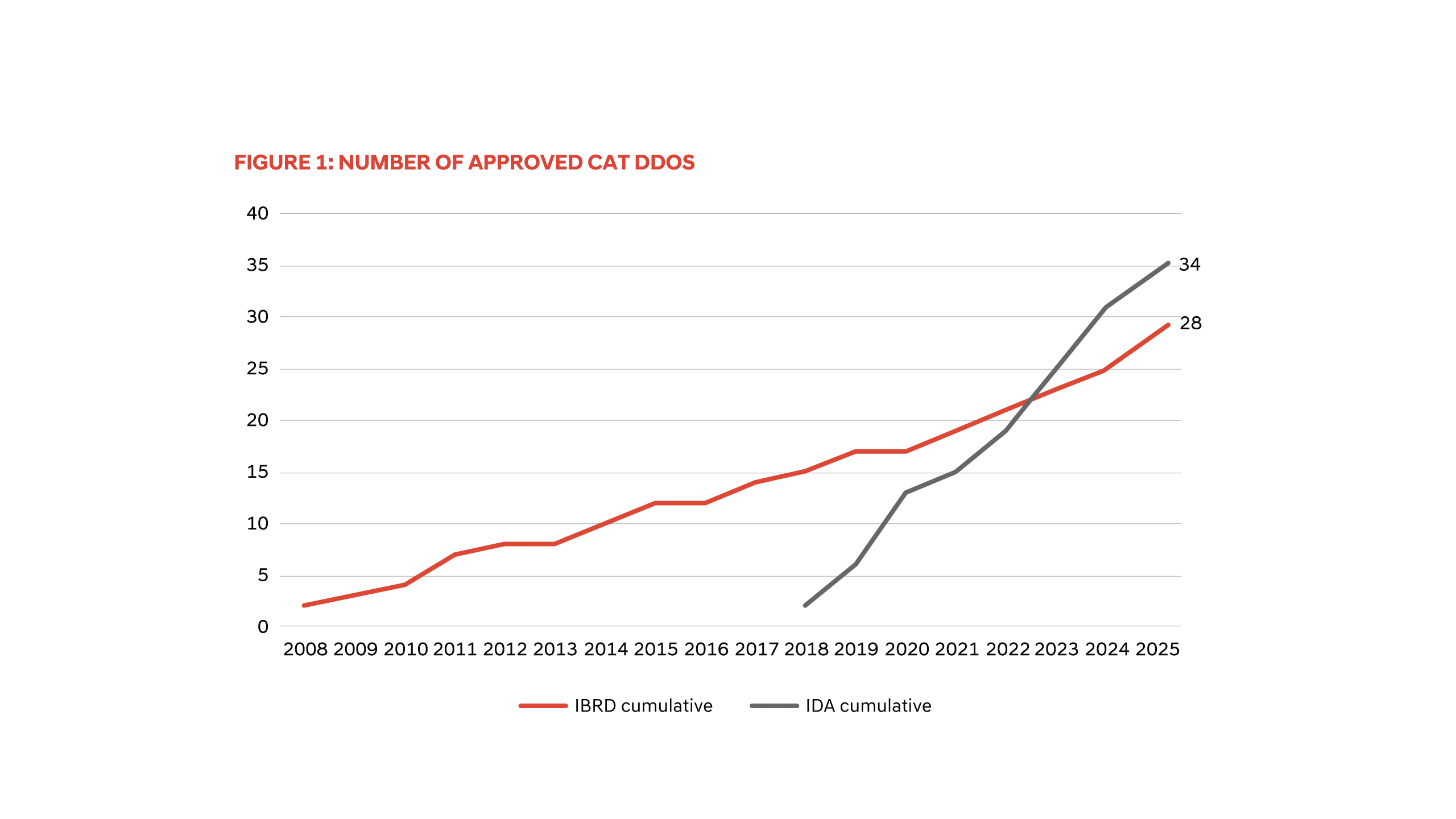
Since Cat DDOs were made available to IDA countries in 2018, the number of approvals has steadily increased—now surpassing those for IBRD countries (Figure 1). For example, in the first six months of 2025, half of the approved new CAT DDOs were in IDA countries: St. Lucia, St. Vincent and the Grenadines, and Vanuatu.
To encourage further uptake in countries where affordability remains a barrier, the World Bank introduced a ‘4-for-1’ offer during the IDA20 cycle. This means that for each quarter of funding coming from country allocations, there is a matching quarter from the IDA Crisis Response Window and a matching half from other general IDA resources. The amounts for IDA countries are a combination of concessional loans and grants, depending on the country’s lending terms. As with other IDA resources, low-income countries with increased vulnerability to debt distress can access grants.
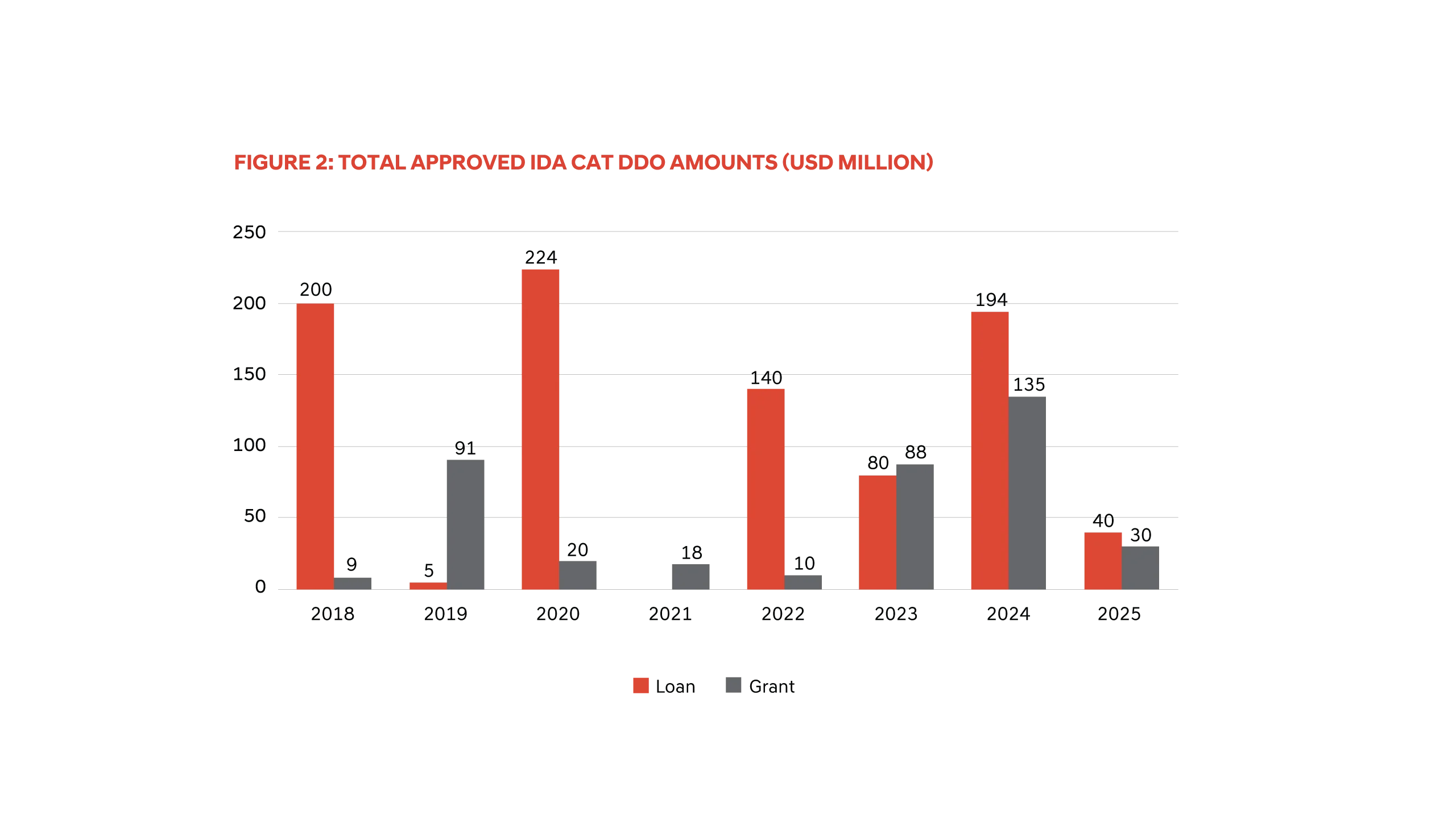
In dollar terms, however, Cat DDOs for IDA countries tend to be much smaller than for IBRD countries, as the ceiling is largely based on a country’s GDP. As a result, the instrument provides less coverage in IDA contexts. Since their introduction in 2018, the total approved amount in IDA countries has been USD1.3 billion, of which approximately a third was in the form of grants (USD401 million) (Figure 2).
With a portfolio limit of USD3 billion (per IDA cycle), however – and total approvals below USD1 billion – there remains significant room to scale up coverage in these countries (Table 2).

In summary, while uptake has grown, the overall size of Cat DDOs in IDA countries remains limited—more accessible, yes, but still modest in financial terms.
Post-pandemic, demand for Cat DDOs is holding strong
Health emergencies have triggered the largest share of Cat DDO payouts to date—USD1.7 billion and 39% of all payouts in total (Figure 3). The vast majority of this was linked to COVID-19. When the pandemic hit, many governments drew on Cat DDOs for fast finance, suggesting the instrument helped fill a gap where few other pre-arranged options existed.
Tropical storms have been another major cause for Cat DDO payouts, representing USD1.6 billion or 36% of all payouts to date. This includes two USD500 million disbursements to the Philippines, in 2011 and in 2018.
.webp)
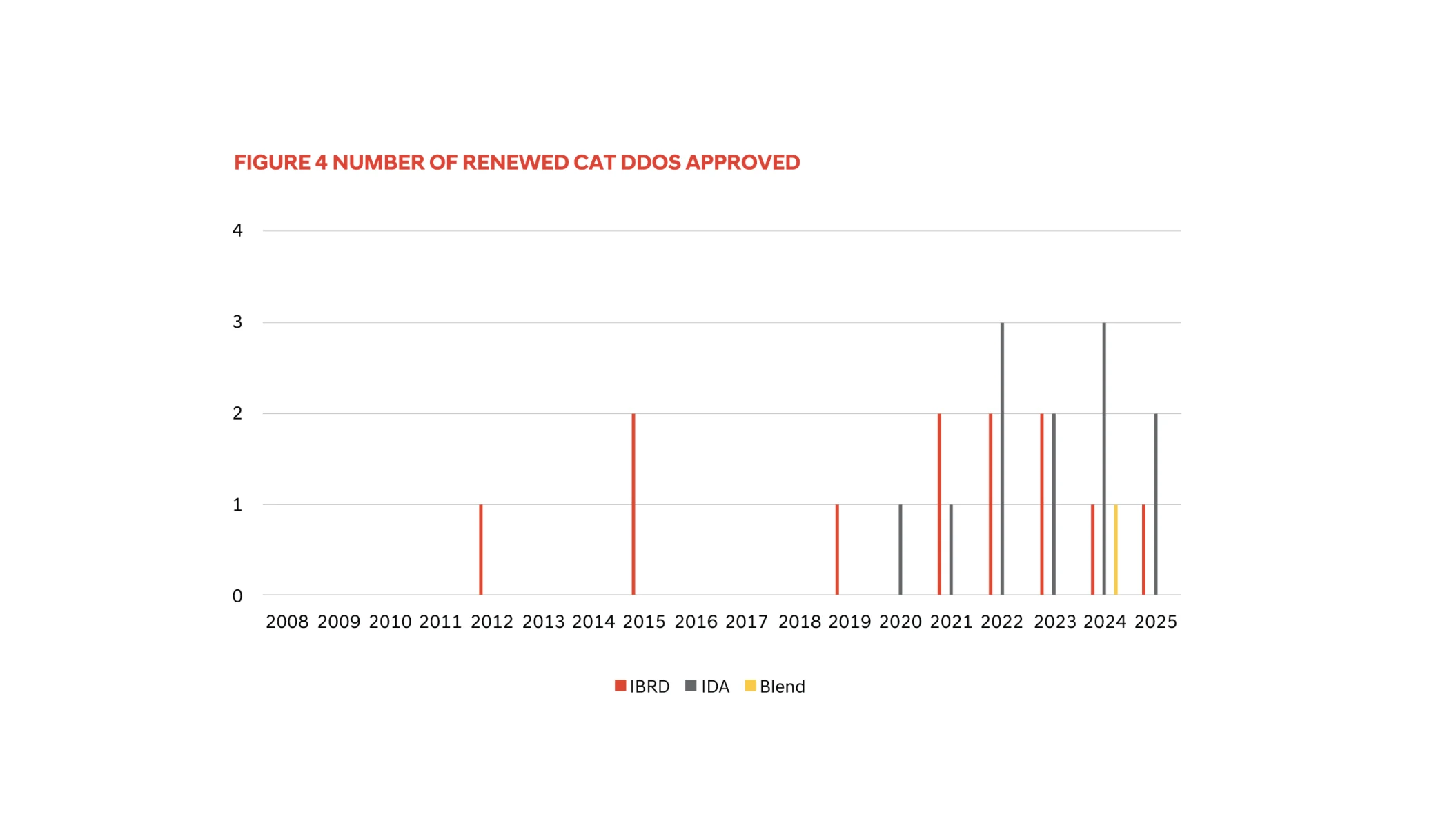
The confidence in Cat DDOs appears to have carried forward. Of the 14 countries that activated a Cat DDO during COVID, nine have since taken out a second—and Colombia is now on its third. These renewals have contributed significantly to the growing number of Cat DDOs approved since 2021 (Figure 4).
Most Cat DDOs are used quickly
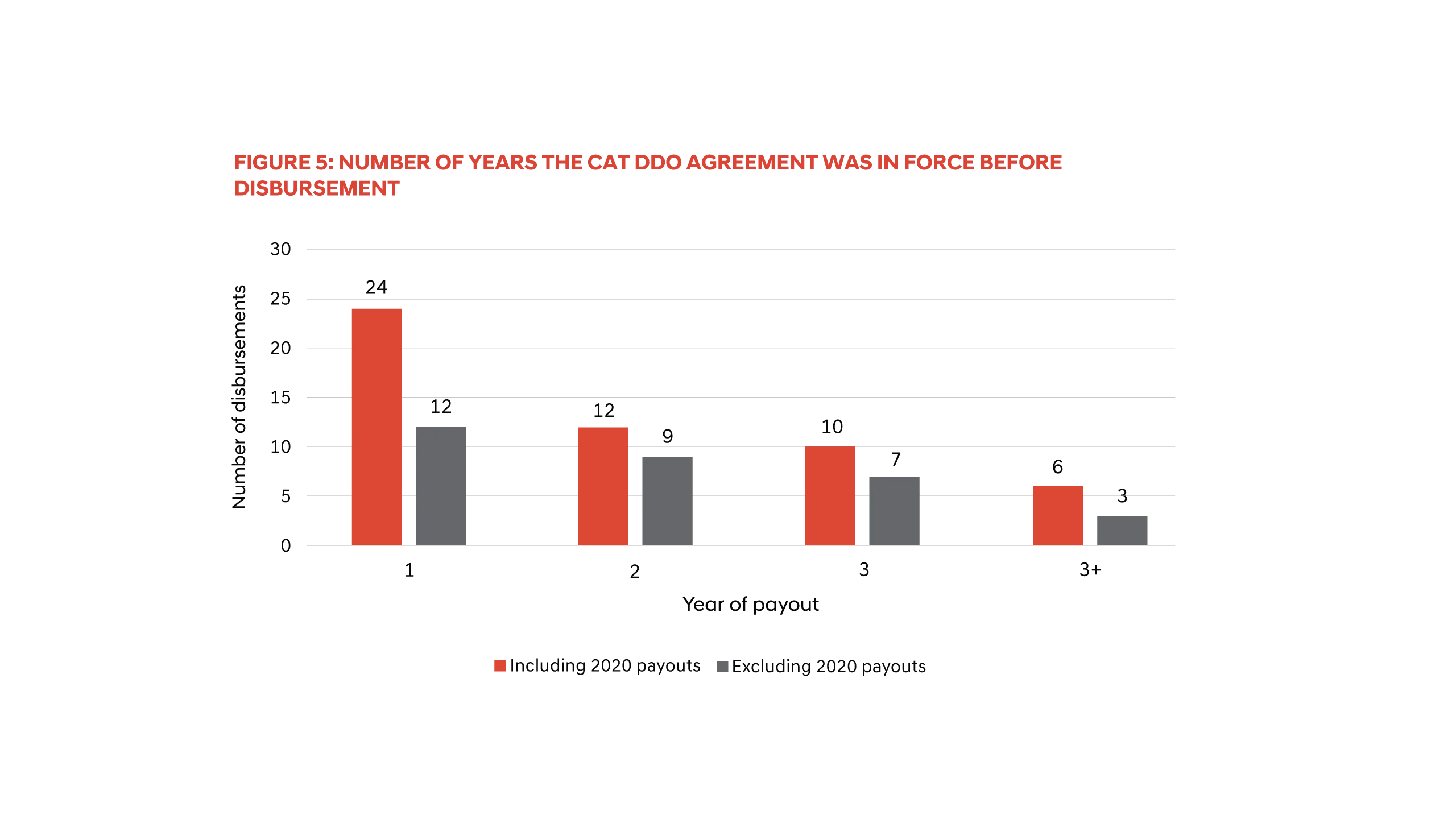
While Cat DDOs can be extended from the default three-year window—up to 15 years for IBRD countries, and up to six years for IDA countries—the data shows they are more often treated as shorter-term emergency financing than a long-term safety net. Of the 65 Cat DDOs approved to date, 34 have fully disbursed, and almost half of all payouts (46%) happened within the first year of approval (Figure 5). Even excluding the COVID-related disbursements in 2020, that figure still holds at around 39%. Only a small share—12% of payouts overall, or 10% excluding 2020—came after the Cat DDO was extended beyond its initial timeframe.
Looking ahead: integrating Cat DDOs into the evolving crisis response toolkit
As part of the IDA21 replenishment, the World Bank announced a series of institutional policy reforms stemming from its Evolution Roadmap, launched in 2023. Among them is a renewed emphasis on crisis preparedness—encouraging more pre-arranged financing and better disaster preparedness in IDA countries.
As one of the Bank’s core pre-arranged financing instruments, the Cat DDO is increasingly central for this focus. With the World Bank now rolling out its crisis toolkit, the key question is how Cat DDOs will fit together with other newly introduced instruments to improve countries’ ability to prepare for—and respond to—future crises.
Analysis in this blog is based on data as of 15 April 2025. In the meantime, Somalia secured a USD20 million Cat DDO.