Fertile grounds, uneven paths: Disaster risk finance and social protection in the Sahel
Over the past three years, the Centre for Disaster Protection has been working with Sahelian governments, the World Bank, and local partners to explore how disaster risk finance can help scale social protection systems in times of crisis.
_pg_v1.1_web.webp)
When droughts hit in Burkina Faso or floods displace families in Chad, governments and their partners face a critical question: how can help arrive faster, more predictably, and at the scale needed? Over the past three years, the Centre for Disaster Protection has been working with Sahelian governments, the World Bank, and local partners to explore how disaster risk finance can help scale social protection systems in times of crisis.
The potential is there. Governments across the Sahel are investing in early warning systems, national response plans and social safety nets. But to deliver faster, fairer support when climate shocks hit, these systems need to be connected, financed, and ready to scale.
When droughts or floods hit, people need help fast. Social protection programmes and systems can play a vital role in responding to climate-related shocks — but their effectiveness depends largely on their ‘adaptiveness’, that is, how rapidly and flexibly they can increase support either for existing recipients or for new groups. However, in the Sahel, scalability is rarely built into planning or budgets, which limits the ability of these systems to deliver when climate emergencies occur.
Over the last three years, funded by FCDO, the Centre for Disaster Protection has provided specialised advisory support to governments in the Sahel region. Working alongside the World Bank Sahel Adaptive Social Protection Program (SASPP) and other stakeholders, we have helped define and put in place strategies to finance adaptive social protection. In this blog, we discuss what we have learnt.
Where shocks meet fertile ground for new solutions
The Sahel region is a complex environment characterised by increasingly frequent droughts and floods, high levels of insecurity and displacement and chronic food insecurity. Governments have very limited fiscal capacity to provide assistance, leaving populations dependent on humanitarian aid and highly vulnerable to future disasters.
Disaster risk finance, channelled through social protection systems, has the potential to improve the timeliness and effectiveness of assistance when crises emerge. However, its success depends on robust institutional arrangements, technical capacity to monitor emerging crises and distribution mechanisms to reach people who need support. It can be easy to assume that regions like the Sahel are just too complicated for new approaches, but our experience challenges this perception.
Being so exposed to disasters has given Sahelian countries the impetus and experience to prioritise planning and preparing for disasters. There has also been substantial external support from humanitarian and development partners (including regional institutions, such as CILSS) to help build capacity. All of this makes the region potentially fertile ground for innovation.

Social protection systems exist, but coverage is still limited
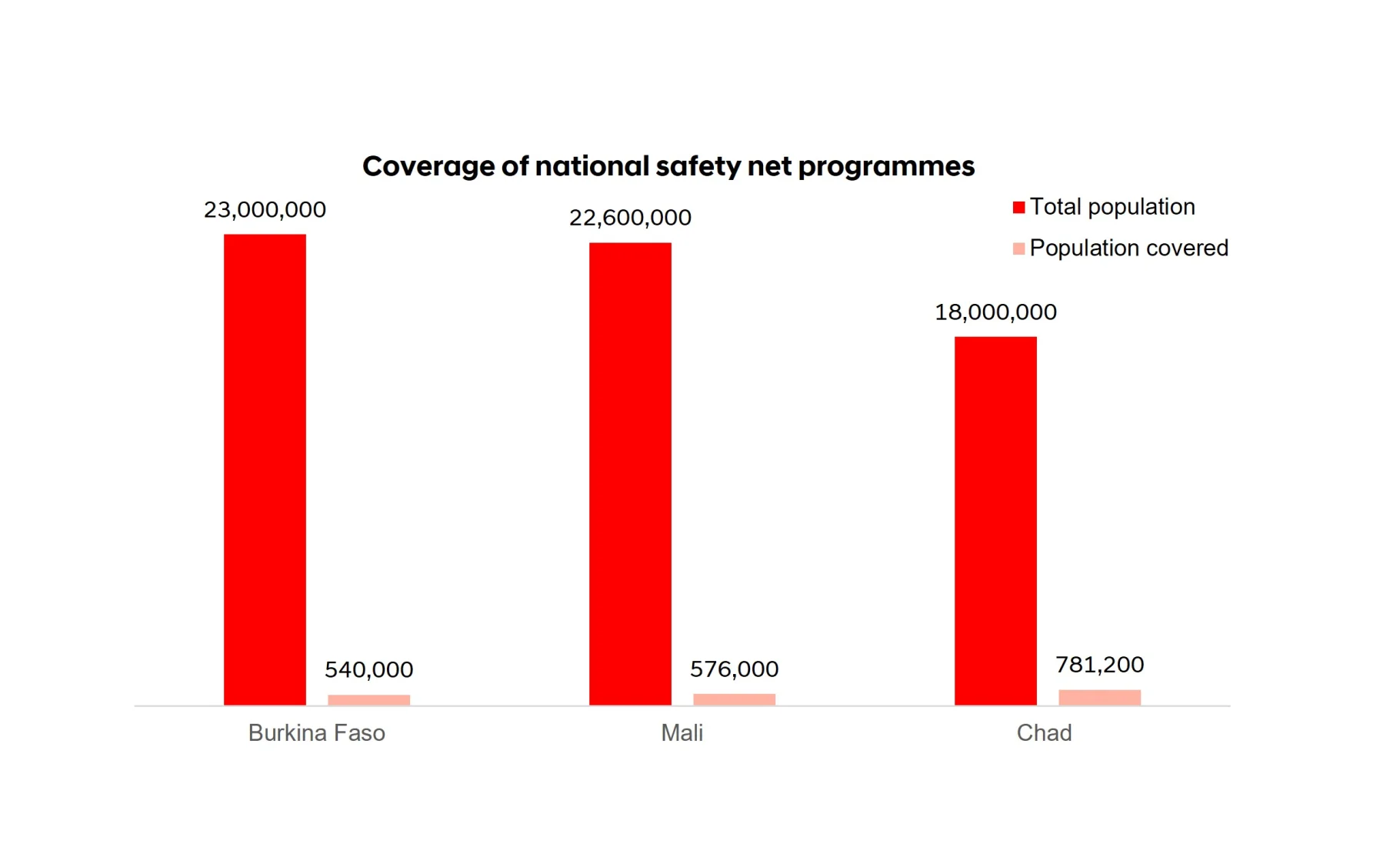
While social protection is low across the Sahel, coverage varies substantially between countries. The percentage of population covered by at least one social protection benefit is estimated at 2.5% in Chad, 9.7% in Burkina Faso, 11.2% in Mauritania, 12.6% in Mali and 20.6% in Niger. Except for Niger, all countries fall below the Sub-Saharan Africa average, which is 15.4% (ILO).
In Chad, Burkina Faso and Mali, where the Centre conducted risk diagnostics, the most scalable social protection initiative is a national social safety net programme (see figure below), which the World Bank has helped operationalise. These ongoing programmes, many of them in their second or third cycle of funding, deliver regular cash transfers to poor and food-insecure households, sometimes bundled with additional support such as livelihood support or public works (paid community-based jobs, like building flood defences).
Governments across the Sahel have ambitious plans to make their national safety nets more adaptive: to scale up in times of shock, although there is little documented experience of this to date. Key to these ambitions are the substantial investments into unified social registries, which allow countries to locate vulnerable people and target them for assistance when shocks occur. These efforts are happening more widely across the Sahel. For example, most of Mauritania is already enrolled into a national registry, although it has been challenging to keep this up to date.
Strong foundations for drought and food insecurity, but gaps remain for other types of crises
Across the Sahel, systems for anticipating and responding to crises are split: one set of institutions and data systems focuses on drought and food insecurity; another, less developed, handles floods and displacement. The former has seen substantial investment and strengthening led by national governments, to improve the capacity to respond to food and nutrition crises. Every year, plans and support scale up and down ahead of the lean season depending on the conditions and the ability of households to cope.
Three areas in the context of drought and food insecurity offer strong entry points for adaptive social protection:
- A shared view of risk. All countries in the Sahel monitor food crises under a nationally-lead participatory process, known as the Cadre Harmonisé. The process consolidates data from numerous sources to make projections of likely levels of food insecurity (using recognised IPC thresholds) ahead of the forthcoming lean season.
- Clear leadership. In several countries recent institutional reforms have clarified and improved the policy and leadership to respond to food crises (often under a dedicated institution, or ‘Dispositif’).
- Annual plans. All five countries now also have a process for a national response plan (‘PNR’), which is developed ahead of the lean season every year based on the projected numbers of food-insecure people based on the Cadre Harmonisé projections. The plan puts the government in the driving seat in initiating and coordinating activities to prevent the escalation of food crises.
In contrast, systems to monitor and respond to other crises are less developed. In some countries, they align more closely with social protection institutions, but overall capacity remains limited. Given how different risks (displacement, conflict, extreme weather) overlap across the Sahel to cause spikes in need, triggers for adaptive social protection should not be linked to any single hazard.
In summary, the tools governments in the Sahel already have (such as the Cadre Harmonisé and the national response plan) and which benefit from government leadership and national buy-in could be quite easily adapted to scale up social protection in response to anticipated food crises. For other kinds of crises (e.g. floods) more investment is needed into developing similar operational frameworks.
Finance is not connected to delivery systems
Governments in the Sahel typically have very limited fiscal space and are heavily reliant on external assistance in the form of humanitarian aid. On average, half of humanitarian appeals are unmet, and funding gaps are most acute in years where there is a spike in requirements. Donors appear to be unable to significantly adjust their financing contributions in response to changes.
Lack of clarity on government contingent liabilities (the potential costs a government would be responsible for) regarding future disaster expenditures is a key limitation across the board. Understanding this, and the macro-fiscal implications of disaster risk, is critically important for governments to buy into the importance of scalable delivery systems (like adaptive social protection) in place ahead of future disasters, and to have sight of the funds that they need to respond effectively.
Nonetheless, there are already government-led national reserve funds in place, largely designed to respond to frequent low-severity shocks, that can deliver scalable support to vulnerable people (like Burkina Faso’s FASA, Mali’s FSA and Chad’s FNSS). Although individually, these are not sufficiently funded and typically have gaps in governance and operational capacity, they offer relevant building blocks for adaptive social protection. The World Bank and partners are already working to strengthen some of these funds, and they could eventually also serve as a vehicle for donor funds.
Finally, the insurance landscape across the Sahel is very limited. At macro-level most governments have some experience of taking out insurance policies from African Risk Capacity against drought, but coverage is very limited and few links are in place to social protection as a distribution channel for payouts. Domestic insurance markets are limited with few financial services for individual farmers who are highly exposed to climate shocks.
Volatility makes the path harder, not impossible
Populations in volatile or fragile countries, like in the Sahel, are typically more exposed to climate shocks than those in more stable areas, due to weakened institutions, degraded infrastructure and social systems. However, the ODI estimate that between 2014 and 2021 only 1% of climate finance reached countries like these, leaving them increasingly falling behind in the race to adapt to a changing climate.
In the Sahel, there are many building blocks in place, representing years of investment by governments with the support of partners, that can be exploited to establish national systems that can deliver timely and predictable assistance ahead of climate shocks. The relative nascency of the social safety net programmes in place could also present an opportunity to leapfrog to more advanced, scalable systems without being weighed down by entrenched and outdated institutions.
The next phase is about connecting the dots between what is already in place: investments in early warning (Cadre Harmonisé) with national response plans and financial triggers; linking those triggers to social registries, and scaling up safety nets when a crisis is forecast.
Assuming stronger coordination and better use of what already exists, the Sahelian countries are on a pathway towards scalable, adaptive systems that can deliver fast, predictable support when disasters strike. And beyond the region, linking early warning, planning, finance and delivery can eventually bolster the financial resilience of countries on the front lines of climate shocks.