Official development assistance (ODA)
Often understood as ‘aid’. The official definition is: “Resource flows to countries and territories on the DAC List of ODA Recipients (developing countries) and to multilateral agencies which are: (a) undertaken by the official sector; (b) with promotion of economic development and welfare as the main objective; (c) at concessional financial terms. In addition to financial flows, technical co-operation is included in aid. Grants, loans and credits for military purposes and transactions that have primarily commercial objectives are excluded. Transfer payments to private individuals (e.g. pensions, reparations or insurance payouts) are in general not counted.” (OECD n.d.).
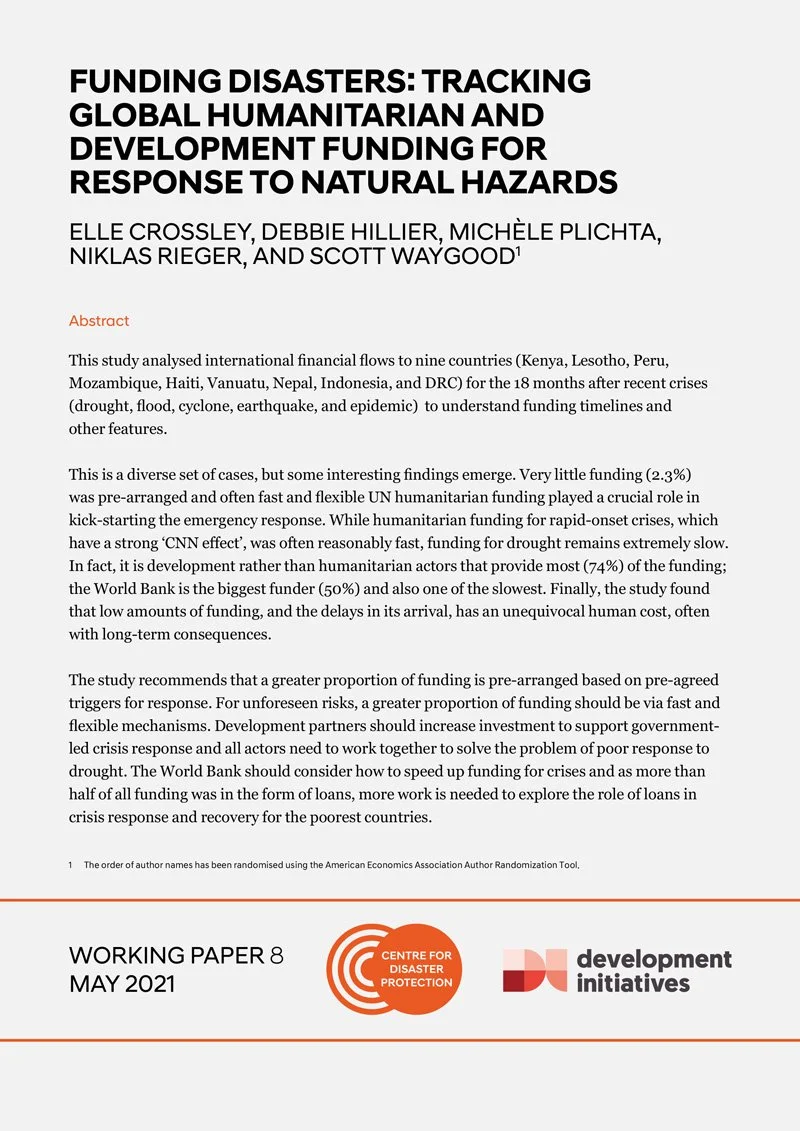
This study analysed international financial flows to nine countries for the 18 months after recent crises to understand funding timelines and other features.
Read more
We explore the key issues in developing a methodology for calculating pre-arranged funding.
Read more
This paper argues that civil society organisations play a vital role in ensuring that crisis financing approaches are designed and delivered effectively.
Read moreResidual risk
The disaster risk that remains in unmanaged form, even when effective disaster risk reduction measures are in place, and for which emergency response and recovery capacities must be maintained (UNDRR 2026).
Other official flows (OOF)
Public funding supporting development that does not meet official aid definitions.
Disaster
A severe event causing widespread harm that exceeds a community’s ability to cope alone.
Total crisis financing
Development funding focused mainly on crisis prevention, preparedness and response activities.
Disaster risk financing
Financial arrangements made in advance to pay for disaster prevention, response and recovery.
Resilience
The ability to withstand shocks, adapt, recover and continue functioning over time.