This outbreak is unprecedented. The flawed financing response isn’t
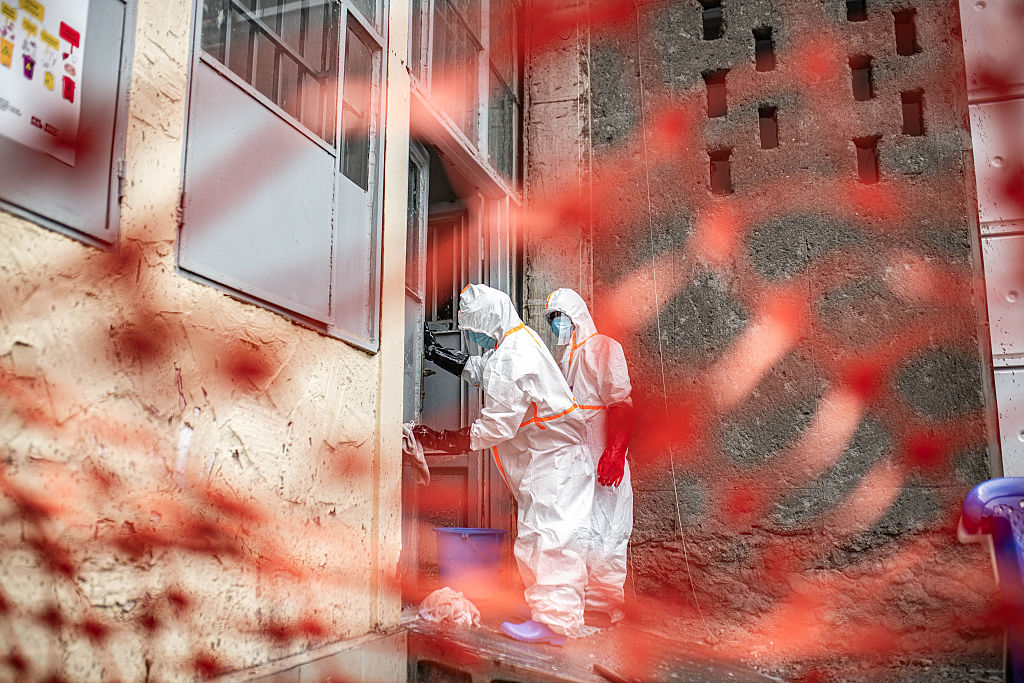
It was May 2019, and I was in a large events hall in Goma — a venue built for social gatherings of the community. We weren’t there to celebrate. We were responding to what was then the second-largest Ebola outbreak on record. With spreadsheets.
This blog post is a longer version of an opinion published by Devex.
The outbreak in the Democratic Republic of Congo (DRC) had been running since late 2018, and donors were losing confidence. They had already committed millions of dollars, the epidemic was still growing, and they were being asked for more. They wanted to know what their money was doing, and they’d asked the World Bank to lead on the financial management of the response. So, a small group from the World Bank’s Global Health team flew to the DRC.
The outbreak was declared over in 2020. At a cost close to US$1 billion. Roughly ten times the total appeals in the first year of the outbreak.
Money in a bank account is not pre-arranged finance
Pre-arranged financing is meant to support predictability in two ways: set money aside before a crisis and establish rules that let the funds move the moment they are needed. In 2019, we had neither. The only pre-arranged finance instrument in existence at the time, the Pandemic Emergency Facility, used its ‘cash window’ to release US$20 million after a donor committee judged the situation grave enough. But what we saw, was the money sitting in an account for months while the government worked out how to spend it.
The remaining funds came through bilateral donations, which were ad-hoc and sometimes earmarked to a single responder.
With no pre-agreed rules for tracking contributions and funding gaps, we built a framework that mapped each donor contribution (the source of funds) to the agency that would spend it against that agency’s mandate and the response activities on the ground. The questions were basic: What is needed to stop transmission? Where? Who is best placed to deliver it? At what cost? Answers to these questions — to the level of local hotspots – restored the donors’ willingness to fund the response.
Same story, less money
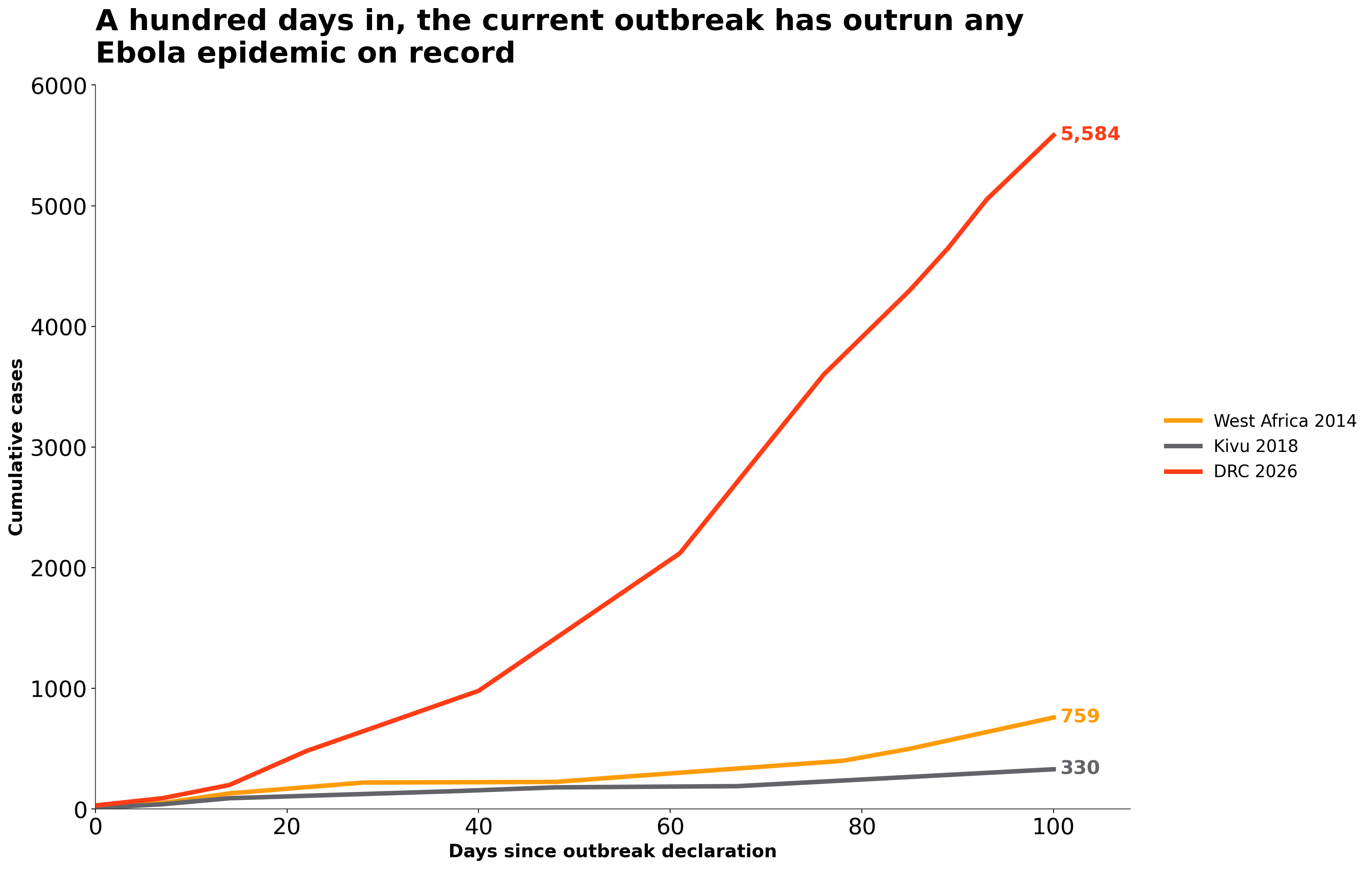
Seven yearson, an outbreak in the same region, caused by the Bundibugyo variant with no licensed vaccine, is moving faster than any Ebola epidemic on record. Based on my analysis, it reached roughly 5,458 confirmed cases by ‘Day 100’, the public health threshold in which an outbreak’s course can still be bent. This is about seven times the number of cases in the West Africa Ebola epidemic of 2014, and 17 times the 2018 Kivu outbreak, at the same stage. Even on the most conservative count: confirmed cases only in 2026, against totals that include confirmed plus probable cases for the 2018 Kivu outbreak, and confirmed, probable and suspected cases for the 2014 West Africa outbreak, it is in a different league. At the time of writing, the death toll had surpassed 3,000 people.
Two current appeals, the United Nations’ humanitarian plan and Africa Centres for Disease Control and Prevention (Africa CDC)’s continental plan — at $US518 million — already total more than $2.5 billion. (In the initial weeks after the continental plan had been released, African nations had pledged US$80 million.) The good news is that US$1.9 billion has been disbursed.
However, nobody seems to know how much is new money rather than reallocated from existing health programmes. Having two major funding appeals adds to the confusion around who does what, and where gaps remain.
Africa CDC’s own financial tracking mechanism, under the continental plan, was built to improve transparency, but is yet to deliver on its promise. On top of the lack of mapping between donor and response activity and duplication risk (the same financing counted twice), an independent review found that neither how much remains unfunded nor where the gaps fall, can be established. All of this means responders are improvising, activity by activity, while donors hesitate over a shortfall no one can size.
We’ve seen this before
The questions on how to stop the outbreak haven’t changed. What has changed is the money and the machinery behind it. Mostly for the worse. The Pandemic Emergency Facility (PEF) was never renewed after it expired in 2020, which we wrote about as “a major step backward”. The United States has withdrawn from the World Health Organization (WHO), dissolved USAID and stepped back from the multilateral response; the WHO’s own emergency contingency fund is nearly exhausted.
The DRC, a fragile state with three decades of conflict, is especially exposed, but an epidemic like this is not confined to fragile states. Uganda — which became Ebola-free at the end of August — and Rwanda have been discussing epidemic insurance, which the African Risk Capacity (ARC) has had available since 2022, covering diseases such as Ebola and Marburg. These are governments with the capacity touse pre-arranged finance well and combine it with preparedness activities and investments in risk reduction. The discussions are yet to materialise in an active policy.
Funding surveillance and vaccine development is essential. But when surveillance is thin and a vaccine cannot be developed fast enough to keep pace with the new variant, the gap between them is measured in money and lives lost. This gap is where pre-arranged finance belongs.
We now pre-arrange disaster finance for earthquakes, floods and, increasingly,droughts, but we still don’t for epidemics. There’s a global ambition to raise the share of crisis financing arranged in advance from 2% to 20% by 2035. This must include financing for epidemics.
Scaled up, insurers such as the ARC can help us get there. But you can’t price insurance for a cost that is not measured. We need better tracking, and we already know what that looks like, because it’s what was built in a hall in 2019: A framework that traces every dollar to what is happening on the ground.
Bring this under one costed plan and a tracker managed by Africa CDC, a strong continental partner that now co-leads the response with WHO, a role it could not have played in 2019.
Have the tracking evaluated by an independent body, and use the evidence to design better financing solutions, before the next epidemic.
Past the hundred-day mark, this outbreak is set to become the deadliest in the history of the disease, and it is being paid for exactly as the last one was: reactively, appeal by appeal. Whatever the eventual tally of pledges, that is not a financing success story.
The expertise is there. We have the tools. The question is whether we’re using them to support governments in the region to never reach such records again.
Key Terms

More Insights
.jpg)
Rewriting the rules of disaster finance
On #DRRDay, UNDRR and the Centre look at why disaster finance needs to cover disaster prevention, not just the cost of recovery.
Read more
Kenya finances resilience as El Niño looms
Kenya’s new disaster risk financing strategy will be tested by a potentially record-breaking El Niño.
Read more.jpg)
Learning disaster risk finance the playful way
Can a game replicate real decision-making better than a workshop ever could? Layer Up!, our new simulation game, is finding out.
Read more