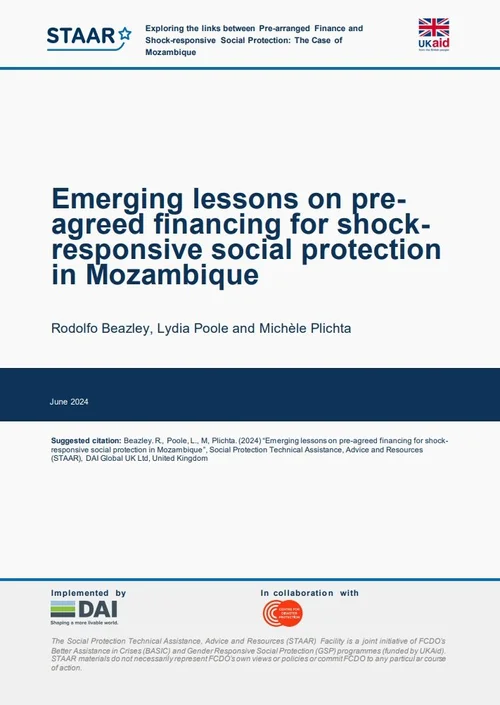
Emerging Lessons On Pre-Agreed Financing For Shock-Responsive Social Protection In Mozambique
This study, conducted by the Centre for Disaster Protection in collaboration with the Social Protection Technical Assistance, Advice, and Resources (STAAR) Facility, investigates the potential opportunities, benefits and risks when linking disaster risk financing (DRF) and shock-responsive social protection (SRSP) in Malawi. The report contributes to a broader study that includes research across three country case studies (Jamaica, Malawi, and Mozambique) to consider the opportunities, potential risks, and benefits of channelling disaster risk financing instruments through national social protection systems. The focus of this report is Malawi.
This study, conducted by the Centre for Disaster Protection in collaboration with the Social Protection Technical Assistance, Advice, and Resources (STAAR) Facility, investigates the potential opportunities, benefits and risks when linking disaster risk financing (DRF) and shock-responsive social protection (SRSP) in Malawi. The report contributes to a broader study that includes research across three country case studies (Jamaica, Malawi, and Mozambique) to consider the opportunities, potential risks, and benefits of channelling disaster risk financing instruments through national social protection systems. The focus of this report is Mozambique.
Key Findings
70%
70% of Mozambicans rely on subsistence agriculture, making livelihoods extremely sensitive to climate shocks such as droughts, floods and cyclones.
$3.2 billion
In 2019, Cyclones Idai and Kenneth struck Mozambique in quick succession. 2.2 million people were in need of urgent humanitarian assistance. Recovery and reconstruction needs were estimated at USD 3.2 billion.
Key Terms Used In This Report
Financial arrangements made in advance to pay for disaster prevention, response and recovery.
Social protection systems that adjust to shocks, helping vulnerable people prepare, cope and recover over time.
Actions taken before a crisis hits to prevent or reduce potential disaster impacts prior to a shock or before acute impacts are felt.
Social protection systems adapted to scale quickly when large shocks affect many people.
Related Publications

The State Of Pre-Arranged Financing For Disasters 2023
This data-led report assesses the state of pre-arranged financing supported with international development financing in low-and middle-income countries.
Read more
Innovations In Sovereign Debt: Taking Debt Pause Clauses To Scale
This insight paper provides an overview of the key features of debt pause clauses, also known as climate resilient debt clauses.
Read more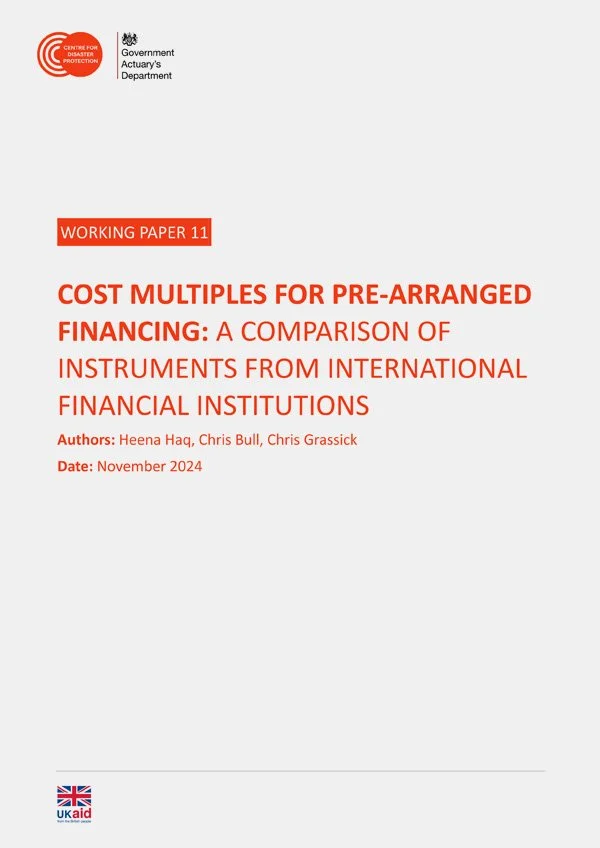
Cost Multiples For Pre-Arranged Financing: A Comparison Of Instruments From International Financial Institutions
This working paper presents a framework that compares contingent loans, grants from multilateral development banks, catastrophe bonds, and insurance provided through regional risk pools.
Read more
Rethinking Premium Support: Enhancing The Impact And Sustainability Of Climate Risk Insurance
This insight paper aims to support policymakers and practitioners as they seek to scale up financial protection against climate-related shocks through sovereign insurance solutions.
Read more