Measuring The Crisis Protection Gap: A Summary Of Research Exploring Technical Approaches For Estimating Global Crisis Protection Costs

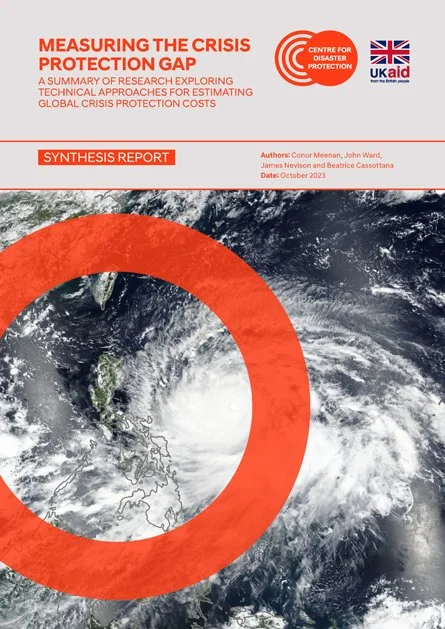
The number of people whose lives are threatened by crises is increasing and current responses are inadequate and inefficient. Pre-arranged financing is a critical component in improving crisis response. Therefore, understanding the gap between crisis financing needs, and how much is pre-arranged, could have a wide range of benefits. This report synthesises research exploring the feasibility of producing quantitative estimates of the costs of crisis protection across a variety of geographies and crisis types. Based on this research it presents a conceptual framework and provides demonstration analyses. The conclusions shine a light both on how it is increasingly possible to generate forward looking estimates of crisis protection gaps, what challenges remain and the benefits of overcoming these challenges.
Measuring the crisis protection gap
The Centre recently published findings from a multi-year research exercise that set out to understand whether it is currently possible to quantify how much money should be pre-arranged to protect low income and vulnerable populations in response to future crises.
Read MoreKey Findings
Key Terms Used In This Report
The difference between expected crisis costs and funding already arranged to cover them.
The network of global organisations funding crisis prevention, preparedness and response.
Financing approved before crises that is released automatically when agreed triggers are met.
Related Publications
.webp)
Financing Adaptive Social Protection In Chad: Disaster Risk Finance Diagnostic
This report on Chad provides an in-depth analysis of the country’s social protection and disaster risk financing landscape to inform future programme design.
Read more.webp)
Debt Pause Clauses Confront Their First Disaster: From Hurricane Beryl To Broader Policy Momentum
This policy brief examines the first real-world use of debt pause clauses - contractual mechanisms that allow sovereign borrowers to temporarily defer debt payments in the wake of a disaster.
Read more
Assessing Value For Money In Pre-Arranged Financing For Disasters: A Practical Framework
This guidance note has been developed to help the increasing number of countries and organisations that are considering or using pre-arranged financing instruments.
Read more