Making Disaster Risk Financing Work For Risk-Affected People
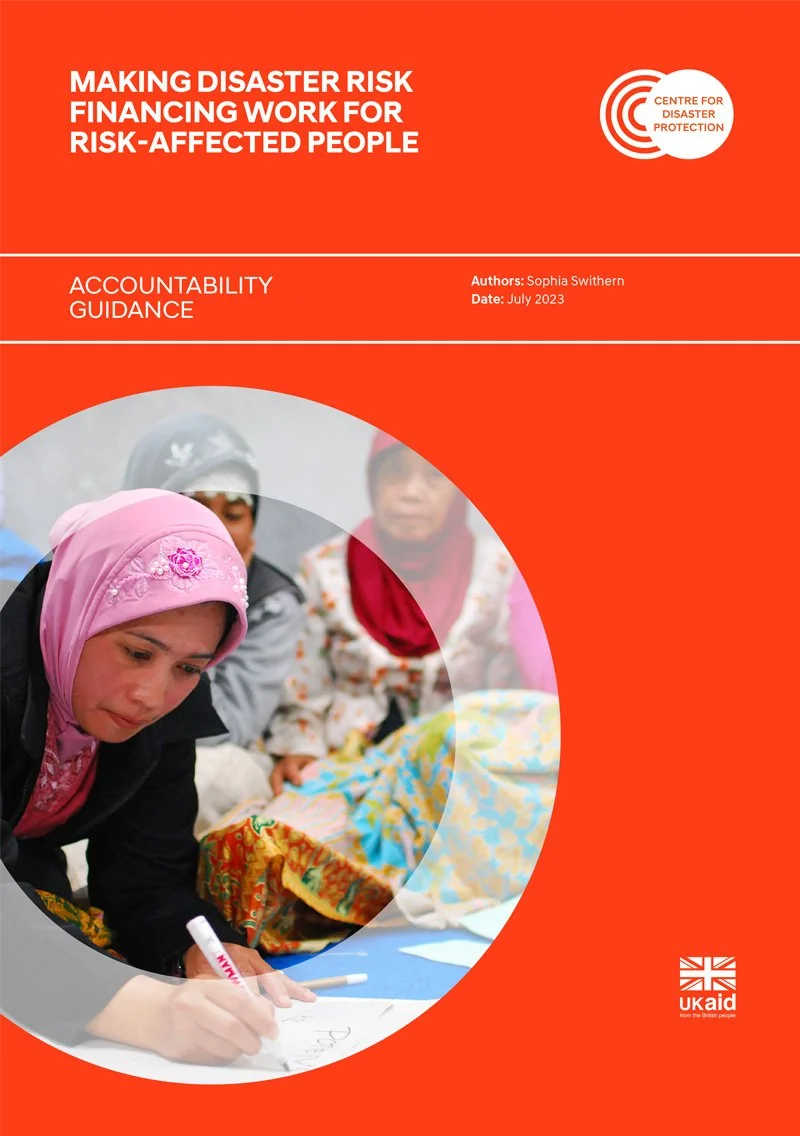
Accountability is a core principle for making Disaster Risk Finance (DRF) work for risk-affected people. Although DRF actors are widely committed to this, there is not yet a shared understanding of what accountability means and how it should be applied. This guidance note is therefore intended as a common framework to support practical approaches to meaningful accountability across the sector, with the aim of assuring financing that is in the best interest of the at-risk communities that it seeks to serve. It can be used by anyone involved in DRF, including those promoting, designing, delivering and supporting DRF.
Because of the diversity of DRF instruments and approaches, this guidance does not seek to provide rigid guidelines for every instrument or organisation to follow. Instead, it is a basic framework that users can adapt to make it most relevant and useful.
_web.webp)
Putting people first in disaster risk finance – the Centre's new accountability guidance
The Centre’s new guidance on accountability provides an accessible framework that applies core elements of accountability to the specificities of DRF instruments.
Read MoreKey Findings
Key Terms Used In This Report
Financial arrangements made in advance to pay for disaster prevention, response and recovery.
Conditions that increase how severely people or communities are affected by hazards.
Skills, systems and resources developed to respond effectively to likely future crises.
Related Publications
Accountability In Disaster Risk Financing
This working paper presents a framework for understanding accountability as well as an overview of implementation.
Read more
Disaster Risk Financing: A Guide To Our Quality Assurance Service
This guidance note provides an overview of the Centre for Disaster Protection’s quality assurance service—a free-to-use and impartial service.
Read more
Focusing On Poverty: Reducing Vulnerability With Disaster Risk Financing
This guidance note sets out some questions to help ensure that DRF is most directed to those who are least able to withstand shocks.
Read more