Paying for anticipatory action in the worst disaster years
A very strong El Niño, forecast to peak around the turn of the year, threatens floods in the Horn of Africa and drought in the western Pacific. In a year like this, early support such as anticipatory action is needed in many places at once, often more than the available funds can pay for. The UN’s emergency fund has taken out the first insurance policy of its kind to protect its portfolio of anticipatory action frameworks that might be impacted by severe disasters.
When disasters arrive together
Anticipatory action means agreeing in advance to release money once a forecast warns of an imminent disaster, such as a flood or drought, so that responders and impacted populations on the ground have the predictability of funding to prepare rather than just wait for help post disaster. It is one of the best-evidenced tools indisaster financing. In Bangladesh, families given cash five days before a flood hit were 62% less likely to go hungry, because they had time to prepare, not scramble to recover after the destruction. Yet anticipatory action remains rare. Only about one dollar in every hundred of humanitarian spending is arranged this way, and the rest is still raised by appeal after disaster strikes. Roughly half of that dollar comes from a single source, the UN’s Central Emergency Response Fund (CERF), run by its Office for the Coordination of Humanitarian Affairs (OCHA).
CERF has about US$150 million committed to such anticipatory action frameworks, across 24 countries covering more than five million people. It has enough cash to pay out early for a big flood or a devastating drought. The danger is a year such as the one ahead, when many frameworks might activate at the same time and payouts fall due together. In an extreme scenario, paying for them all would mean drawing money from CERF’s other work, including protracted crises such as the one in South Sudan.
That trade-off has become harder. As humanitarian funding fell by around 30% from its 2022 peak, humanitarian agencies were forced to concentrate on the most severe events. Development funders retreated too: official development assistance fell by 23% in 2025, the steepest annual fall on record, and moved towards the safest places. A growing number of fragile places now fall between the two.
After assessing its options, OCHA realised that raising additional capital after a disaster wouldn’t be enough to close this gap. Money raised after a disaster is the slowest and costliest way to protect lives. It must be arranged differently: before crises strike, and by transparent rules.
Insurance suits the severe year
Insurance is an efficient way to pay for rare but severe events but can also be prohibitively expensive if used to pay for things that happen often. That is why CERF’s insurance policy sits between the two, covering years when anticipatory action spending is unusually high while regular early-action spending is retained within its own budget. This first such indemnity insurance policy for the UN will pay out once the anticipatory action spending over the policy period passes US$61.5 million, which OCHA expects to reflect a 10% probability in any given year (or about one-in-ten year return period), and can pay up to US$40 million.
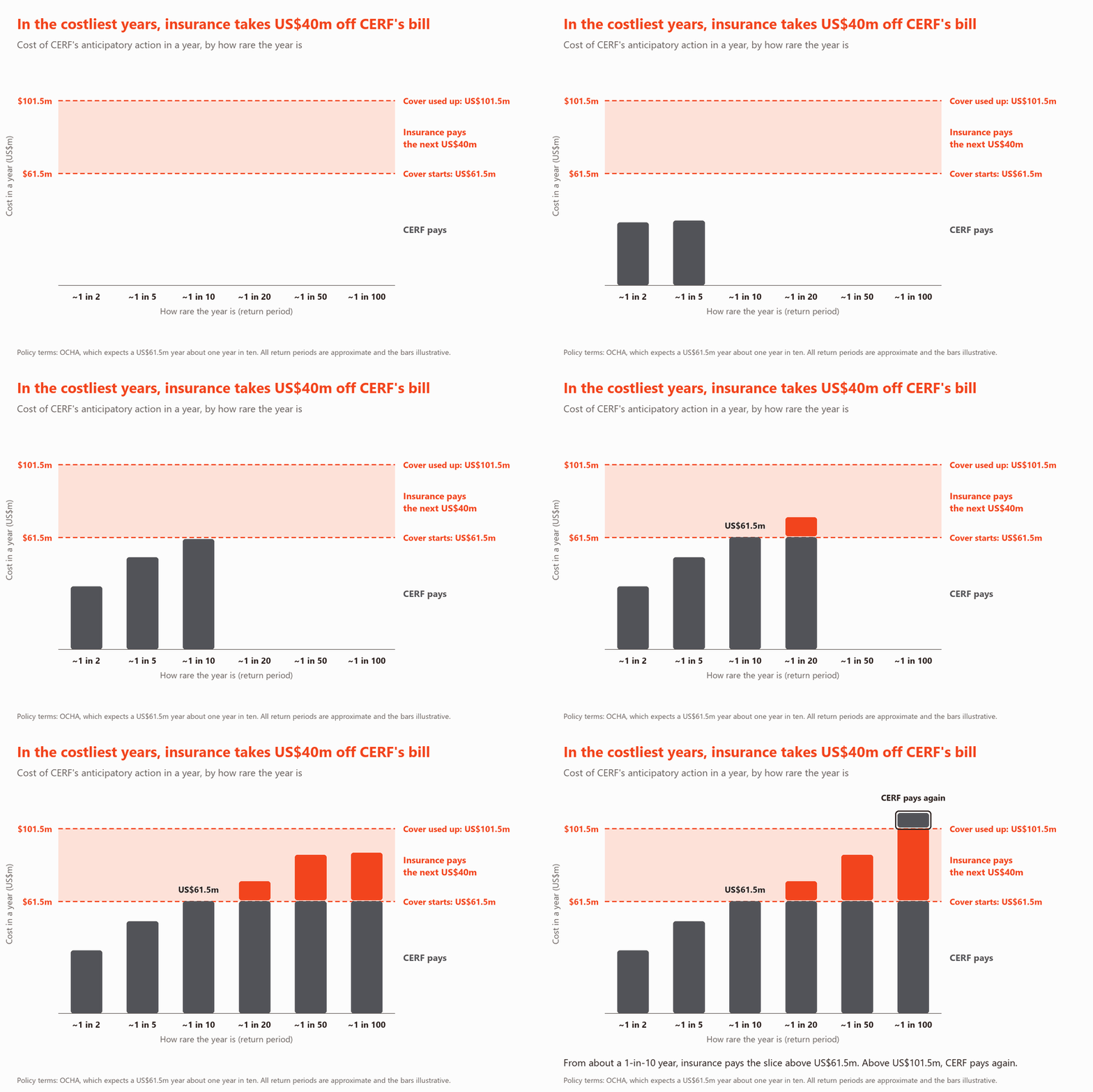
Nobody buys car insurance hoping to crash; but having bought car insurance is what lets you drive further with confidence. Similarly, in the case of OCHA and the CERF, in most years the indemnity insurance cover will not pay out, by design. Its value lies in the predictability it gives. Knowing a bad year is covered, CERF needs to keep less money as a reserve and can more confidently extend its reach to fund anticipatory action in more places.
At the same time, an insurer will only cover a risk it can put a number on: understanding how often they will have to pay, and how much. CERF’s anticipatory action portfolio allowed for that actuarial analysis, because the money is released following triggers and rules set in advance, such as a rainfall forecast passing a set level in a certain country. Given OCHA’s transparency, the broker and the reinsurance markets have received the data that allowed them to model and run simulations of those rules over two decades of past forecasts and estimate how often the insurance policy would pay out. That insurers were willing to take on the risk is a sign of market confidence in how OCHA runs its anticipatory action.
Who pays?
The insurance premiums for CERF’s initial insurance cover are paid by the Global Shield Financing Facility, the UK and Sweden, mostly from climate, development and disaster risk finance budgets. For these funders, help that arrives before a disaster will cost less than help needed once it has occurred. It also protects the development gains their own spending is meant to secure, in the fragile places they find hardest to invest in.
The donors have committed to paying the premiums for the first three years. OCHA has committed to impartial assessment of the cost-benefit and effectiveness of the programme’s first three years to generate evidence to cement longer-term support from donors. The harder task comes after: making insurance premiums a normal running cost for the UN and finding ways to build up enough money of its own to carry more of the risk itself before it buys cover.
Beyond a single agency
The UN OCHA indemnity insurance backstop is innovative. But without a way to capitalise on the work that already went into it, the next agency seeking a similar cover would have to start from zero and pay the full cost alone. Sharing know-how and risk with other agencies would make the next such pilot more affordable. In a bad year, each humanitarian agency is left to fend for itself, competing for the same limited funding once disaster has struck. Agencies that share risk analysis, buy protection as one and share the load in bad years can reach further than any could alone.
Following OCHA’s lead, UNICEF has bought similar cover for its US$5 million portfolio of 10 anticipatory action frameworks, using the same data, models and broker. The two policies are separate, but a shared approach signals the first step towards a future where agencies could insure against their bad years together. An agency buying cover alone leaves gaps in places and hazards it judges too costly, or too far outside its work, to protect, and misses the savings that come from sharing risk. In a shared pool, each place costs less to cover than it would alone, because a disaster there is unlikely to strike at the same time as everywhere else the pool covers. More agencies mean more protection in the fragile places that would otherwise be left unprotected.
The UN Disaster Risk Finance Platform for Pre-Arranged Humanitarian Financing, launched at COP31, is designed to help the humanitarian sector take that step. Backed by six UN agencies, with the UK and Germany among its early partners, it lets agencies approach markets together, for both anticipatory action and rapid response. By 2030 it aims to support more than US$3 billion in pre-arranged finance, protecting more than 75 million people. Whether it gets there doesn’t depend on just the number of agencies signing up. Their plans must meet the same standards of data and rules that made CERF’s cover possible, and shared cover must reach the places no agency would protect alone. Get these right, and a bad year need not decide who is protected and who is not.
Juan Chaves-Gonzalez is Lead Advisor for Crisis Risk Financing at OCHA. The Centre for Disaster Protection provided independent technical advice to OCHA on the policy. A forthcoming piece by Amar Patel will look at when pooling saves money, and when it does not.

Anticipatory Crisis Financing And Action
Authored by



More Insights
Rewriting the rules of disaster finance
On #DRRDay, UNDRR and the Centre look at why disaster finance needs to cover disaster prevention, not just the cost of recovery.
Read more
Kenya finances resilience as El Niño looms
Kenya’s new disaster risk financing strategy will be tested by a potentially record-breaking El Niño.
Read more
The DRC’s Ebola outbreak is the fastest on record. The type of financing and hurdles behind the response look almost exactly as it did seven years ago.
Read more